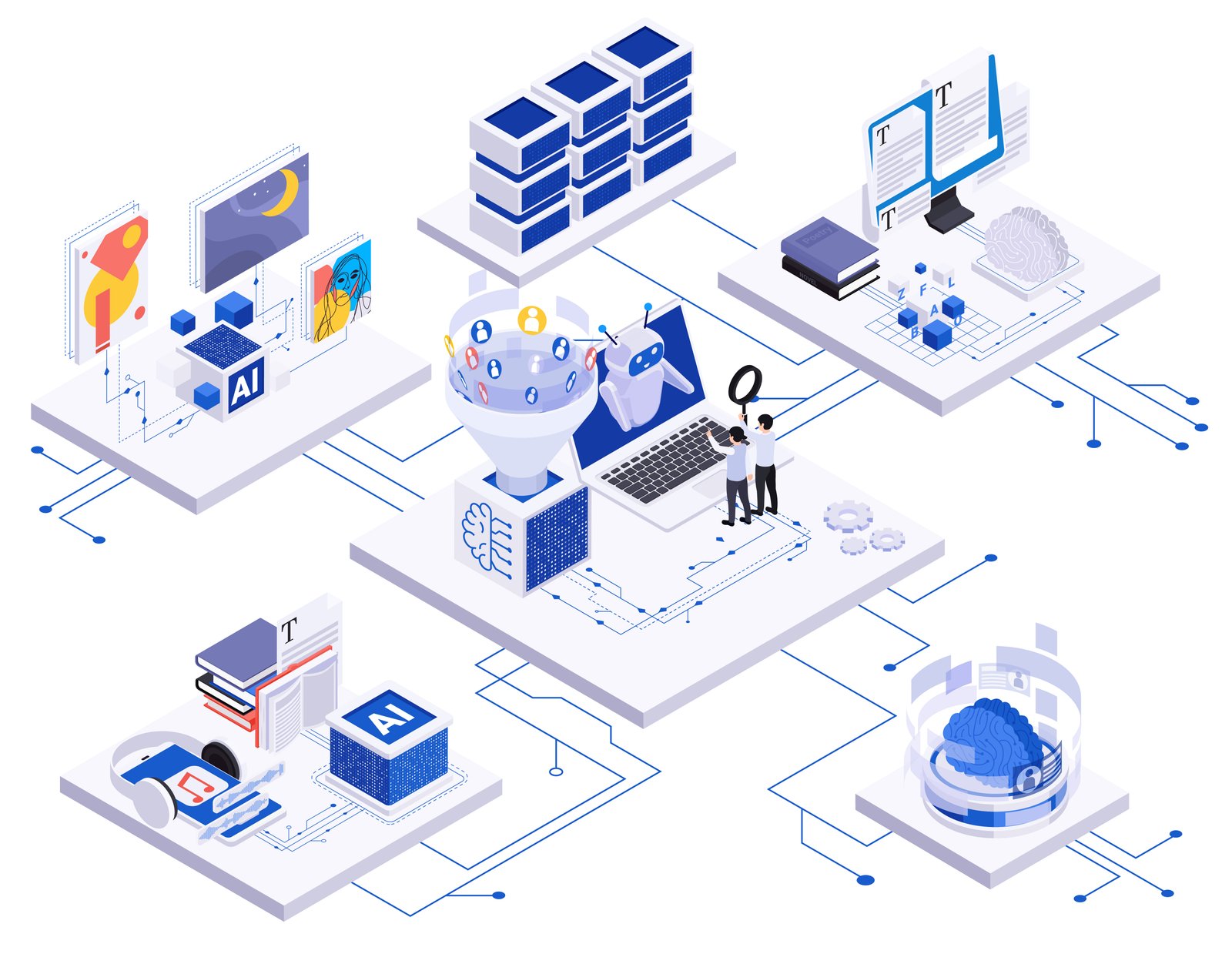
Enterprise AI is entering a different phase. The question is no longer whether a model can generate useful output. The question is whether an organization can safely connect intelligence to the systems, information and workflows that create business value.
The competitive advantage will not come from having access to AI. It will come from building an enterprise capable of operating with it.
The AI shift is architectural
The first wave of enterprise generative AI was dominated by experimentation: chat interfaces, productivity assistants, document summarization, coding tools and isolated proofs of concept.
These applications demonstrated that foundation models could create meaningful value across knowledge-intensive work.
But enterprise-scale value requires something different.
AI needs access to the right enterprise context. It needs controlled access to tools. It needs reliable data. It needs identity, permissions, monitoring and clear boundaries around what it is allowed to do.
That is why current enterprise AI architecture increasingly focuses on orchestration, governance, integration and operational controls rather than treating the model as the entire solution.
Why AI pilots struggle to become production systems
A prototype can succeed with a small dataset, a handful of users and a narrowly defined workflow. Production enterprise AI operates under a very different set of conditions.
It must handle changing data, multiple users, permissions, security policies, operational failures, cost constraints and increasingly complex workflows.
The model is only one component
A production AI capability is better understood as a system rather than a model.
The system needs access to trustworthy, relevant and appropriately governed enterprise information.
Foundation models or specialized models provide reasoning and generation capabilities.
Workflows determine how models, tools, data and business systems interact.
Identity, permissions, policy, validation and human oversight establish operational boundaries.
Production systems require visibility into performance, cost, behavior, failures and outcomes.
The enterprise AI architecture
The architecture should be designed around the business workflow rather than around a particular model.
A modern enterprise AI environment can combine applications, models, knowledge systems, tools, orchestration and governance into a controlled operating layer.
Intelligence connected to the enterprise
Experience Layer
Interfaces through which employees, customers and operational teams interact with AI capabilities.
Agent & Orchestration Layer
Coordinates reasoning, task planning, workflow execution and interactions between specialized AI capabilities.
Model Layer
Connects approved foundation models, specialized models and task-specific intelligence according to business requirements.
Enterprise Knowledge Layer
Provides governed access to documents, databases, knowledge repositories, vector indexes and other enterprise information sources.
Tools & Integration Layer
Allows AI systems to interact with approved business applications, APIs and operational systems.
Governance & Observability
Provides identity, authorization, policy enforcement, auditability, monitoring, evaluation and cost controls across the environment.
The important principle is architectural separation: intelligence should be powerful, but the systems surrounding it should determine what that intelligence is allowed to access and execute.
Governance cannot be an afterthought
As AI systems become capable of taking actions, governance changes from an approval process into an architectural capability.
A chatbot that produces a draft response has one risk profile. An agent that can access customer records, modify an order, initiate a transaction or trigger an operational workflow has another.
The second system needs explicit identity, authorization, policy boundaries and traceability.
The more autonomy an AI system receives, the more important its control architecture becomes.
Three control dimensions
Identity
Know which user, agent, service or system is requesting an action and establish the authority associated with it.
Authority
Restrict which data, tools and business actions an AI system can access according to role, context and policy.
Evidence
Maintain sufficient records to understand what happened, why it happened and which systems or people were involved.
From copilots to enterprise agents
Copilots assist people. Agents can increasingly execute multi-step workflows.
This distinction is important because execution introduces a new architectural requirement: bounded autonomy.
An enterprise agent should not simply have a goal and unrestricted access to systems. Its role, available tools, data boundaries and decision rights should be deliberately defined.
The agent as an enterprise actor
A useful way to think about an enterprise AI agent is as a software actor with a defined identity, responsibility and authority.
This becomes particularly important as organizations deploy multiple specialized agents across finance, procurement, customer service, operations, engineering and other functions.
Human oversight should be designed into the workflow
Not every decision should require a human. Not every decision should be fully autonomous.
The right model depends on risk.
Routine, reversible actions can often be automated with limited intervention.
AI can prepare or recommend actions while defined approval gates remain in the workflow.
Human authorization, stronger verification and comprehensive audit controls should remain mandatory.
Scaling AI is an operating-model problem
Organizations often measure AI maturity by counting pilots. A more useful measure is how deeply AI has become integrated into repeatable business operations.
The architecture therefore needs to be designed for evolution. Models will change. Vendors will change. Interfaces will change. Business workflows will change.
The underlying enterprise architecture should make those changes possible without rebuilding the entire system each time.
Questions technology leaders should ask
Before launching another AI initiative, CIOs, CTOs and enterprise leaders should examine the foundation underneath the use case.
AI should be connected to measurable operational or strategic value rather than technology adoption alone.
A powerful model cannot compensate for inaccessible, inconsistent or poorly governed enterprise information.
Define the exact tools, systems and actions available to every AI capability.
Establish explicit approval, authorization, monitoring and escalation paths before increasing autonomy.
The platform should allow models, workflows, data sources and AI capabilities to change without destabilizing the enterprise.
Build intelligence into the business
Enterprise AI will not be defined by the number of models an organization can access.
It will be defined by how effectively intelligence can operate inside the business.
That means connecting AI to trusted enterprise data, integrating it with operational systems, controlling its authority, monitoring its behavior and designing workflows where humans and machines can work together.
The organizations that build this foundation early will have a significant advantage as AI capabilities continue to evolve.
The future enterprise is not simply AI-powered. It is architected to operate with intelligence.